
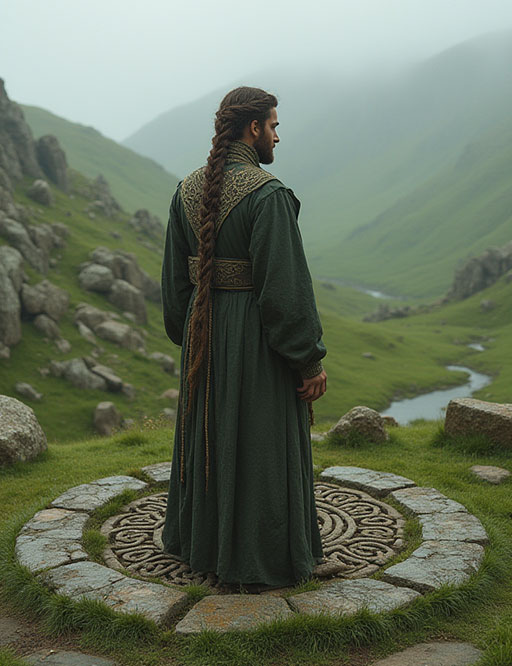
Picture the rugged coastlines of Ireland and the misty highlands of Scotland. There’s a certain magic that clings to these lands, a feeling that the ancient world is just beneath the surface. This is the heartland of the Celtic culture, a family of traditions linked by language, art, and a unique way of seeing the world.
While the ancient Celts were a diverse group of peoples spread across Europe, their spirit lives on most powerfully in places like Ireland and Scotland. The Celtic culture is not just a history lesson; it’s a living, breathing force you can still feel in the music, see in the art, and hear in the stories.
The Language of Knots and Spirals
One of the most recognizable parts of Celtic art is its intricate knotwork. These are not just pretty, looping lines. They are a philosophy made visible. The endless, interwoven paths have no beginning and no end, symbolizing:
-
Eternity and the cyclical nature of life.
-
The unbreakable bonds of loyalty, family, and love.
-
The interconnectedness of all things in the universe.
Alongside the knots, you’ll find the triskele, or triple spiral. This powerful symbol represents the power of three in all its forms—the cycle of life, death, and rebirth; the realms of earth, sea, and sky; and the past, present, and future. It’s a reminder that everything is in constant motion.
A World Bathed in Magic
The Celtic worldview was one where the veil between our world and the Otherworld was incredibly thin. The Otherworld, or Tír na nÓg, wasn’t a heaven or hell, but a parallel reality of magic, beauty, and timelessness, inhabited by gods, fairies, and spirits.
This belief was rooted in a deep, spiritual connection to nature. The divine wasn’t in some distant place; it was in the sacred oak grove, the bubbling spring, the towering mountain.
Their year was marked by four great fire festivals that honored the changing seasons. The most famous is Samhain (pronounced ‘sow-in’), the festival that marked the end of the harvest and the beginning of winter’s darkness. It was a time when the veil between the worlds was at its thinnest, when spirits could walk the earth. It is the ancient root of our modern Halloween.
The Power of the Spoken Word
In a world without widespread writing, the most valuable people were the keepers of memory. The bards and the seanchaí (storytellers) were the living libraries of the Celtic people. They memorized thousands of stories, epic poems, family lineages, and the complex laws that governed society.
Loyalty wasn’t to a king or a country in the modern sense, but to the clan—the extended family. Your kin were your world, your protection, and your identity. And the bards were the ones who held the stories of your ancestors, giving you your place in that world. Their epic tales, like those of the Irish hero Cú Chulainn, were the heart and soul of the culture.
The Heartbeat is Still Strong
The ancient Celtic culture is not gone. You can find it, alive and well, in the corner of a pub in Dublin or a village hall on the Isle of Skye. The most vibrant part of its legacy is the music. The lively, soulful sound of the fiddle, tin whistle, pipes, and bodhrán is the culture’s living heartbeat.
And the ancient languages, Irish Gaeilge and Scottish Gaelic, which were once suppressed, are being spoken with renewed pride. This isn’t a culture trapped in stone carvings; it’s a dynamic tradition, still telling its story, still singing its song, its eternal knot unbroken.


