
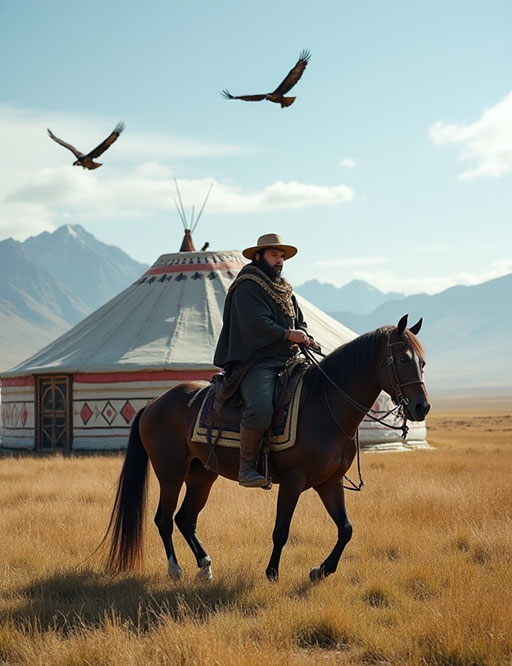
The story of Mongolia is the story of a people in constant motion, a life lived in harmony with the cycles of the seasons across one of the most sparsely populated landscapes on Earth. It’s a culture forged in the saddle and shaped by the endless, rolling grasslands known as the steppe.
The Horse and the Endless Sky
In Mongolia, it is said that “A Mongol without a horse is like a bird without wings.” The horse is not just an animal; it is the center of the universe. Children learn to ride almost as soon as they can walk, becoming expert equestrians. The horse provides transportation, companionship, and the milk that is fermented into their famous national drink, airag.
This deep bond with the horse is a symbol of their connection to the land and to Tengger, the eternal Blue Sky, their supreme deity. Life is lived under this endless sky, open and exposed to the elements, fostering a spirit of incredible toughness and self-reliance.
The Home That Moves: The Ger
How do you live a life of constant movement? The answer is the ger (known elsewhere as a yurt), a masterpiece of nomadic engineering. This circular, felt-covered dwelling can be taken down and packed onto a camel or cart in a matter of hours, and reassembled just as quickly in a new pasture.
The ger is more than a tent; it’s a cosmos in miniature. The single door always faces south. The back, the most honored position, is for elders and sacred objects. The west side is for the men and their tools; the east side is for the women and the kitchen. The smoke hole at the top is the family’s connection to the sky. It is a warm, efficient, and deeply symbolic home, perfectly adapted to a life on the move.
Hospitality of the Steppe
In a land so vast and empty, hospitality is not just a virtue; it is a law of survival. Any traveler, stranger or friend, is welcome in any ger. Upon entering, you will be offered a bowl of suutei tsai (salty milk tea) and something to eat, like dried curds (aaruul).
There are no fences on the steppe. The land is for everyone. This open-heartedness and generosity is a defining characteristic of the Mongolian culture. It is a social contract born from a shared reliance on the land and on each other.
The Shadow of the Great Khan
You cannot speak of Mongolia without speaking of its most famous son: Chinggis Khaan (Genghis Khan). He is not seen as the ruthless conqueror known in the West, but as the revered founding father of the nation. He was the great unifier who brought the warring nomadic tribes together and created the largest contiguous land empire in world history.
Today, Chinggis Khaan is the ultimate symbol of Mongolian strength, pride, and national identity. His legacy is a reminder of a time when these horsemen from the steppe changed the course of world history. This immense pride in their past fuels the resilience of the Mongolian people today.


