
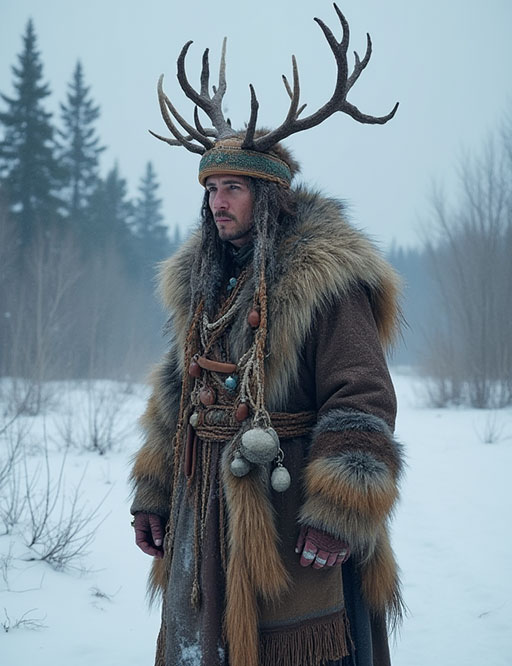
The Sakha are a Turkic people, whose ancestors migrated north centuries ago, bringing their unique language and traditions into the heart of Siberia. Their entire culture is a masterclass in adaptation, not just surviving the extreme cold but building a rich spiritual and artistic life in its midst. Their story is one of incredible hardiness, a deep love for their land, and a community spirit that generates a powerful warmth against the frost.
The Horse That Breathes Steam
At the very soul of the Sakha people is an animal as tough as the land itself: the Yakutian horse. This is not a sleek, graceful steed; it is a compact, shaggy, and incredibly resilient creature, a true marvel of evolution. It can withstand the most extreme temperatures on the planet, using its hooves to dig for frozen grass buried under deep snow.
For the Sakha, this horse is everything. It is a vital source of meat and milk—which is fermented into a celebratory drink called kumis—but more than that, it is the ultimate symbol of life and freedom. The image of these horses, their breath turning to ice crystals in the frozen air, is the perfect metaphor for the Sakha people themselves: tough, enduring, and perfectly adapted to their world.
The Sun’s Great Return: The Yhyakh Festival
After a long, dark, and brutally cold winter, the arrival of summer is a cause for the year’s most important celebration. The Yhyakh festival, held around the summer solstice, is the Sakha New Year, a joyous explosion of tradition and community. It is a multi-day festival dedicated to honoring the Aiyy (benevolent sky deities) and celebrating the rebirth of nature.
The festival is filled with sacred rituals:
-
A shaman feeds a sacred bonfire with offerings of kumis and butter, sending prayers to the gods.
-
People drink kumis from ornately carved wooden goblets called choroon.
-
The most spectacular event is the Osuokhai, a massive, continuous circle dance. Thousands of people hold hands, moving in a slow, hypnotic, spiraling dance that mimics the sun’s path. It can last for hours, even days, uniting the entire community in a single, powerful prayer for a good year.
The Voice of the Epics and the Spirits
The Yakut culture has a rich oral tradition, best exemplified by the Olonkho. These are ancient heroic epics of incredible length and complexity, recognized by UNESCO as a masterpiece of intangible heritage. A master Olonkho storyteller can perform for days, chanting the tales of ancient heroes, gods, and the creation of the world, keeping the entire history and mythology of the people alive.
Their music has a unique, otherworldly sound, often centered on the khomus, or jaw harp. A skilled player can use the khomus to mimic the sounds of nature—the wind, the call of a bird, the hoofbeats of a horse—creating a vibrating, meditative soundscape that is the very voice of the tundra. This music is deeply connected to their traditional shamanistic beliefs, a reverence for the spirits (ichchi) that inhabit the sky, the earth, and everything in between.
The Sakha culture is a powerful testament to the human spirit’s ability to create warmth, beauty, and community in the most challenging conditions on Earth. They are the true people of the north, whose spirit burns brightly against the cold.


