
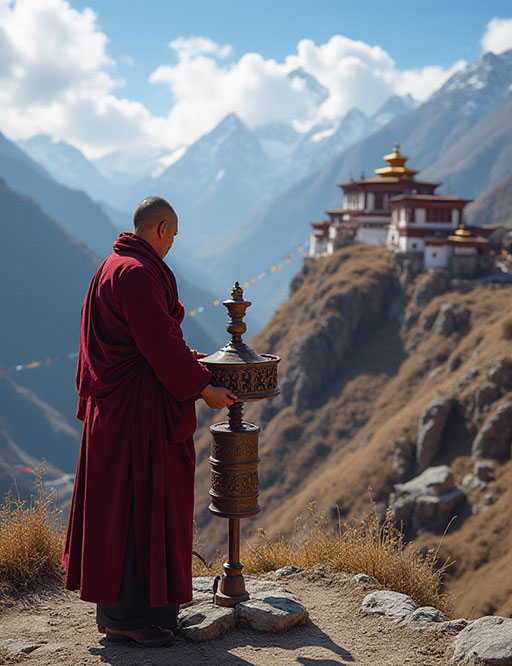
Life in Tibet is a life lived between a sacred earth and a holy sky. The culture is shaped by the immense, high-altitude landscape and is saturated in every aspect by the teachings of Tibetan Buddhism. It is a worldview built on the interconnectedness of all living things and the boundless power of compassion.
A Universe of Compassion: Tibetan Buddhism
You cannot separate Tibetan culture from Tibetan Buddhism; they are woven from the same thread. It is a complete way of life, guiding everything from daily interactions to art and medicine. At its core are a few profound ideas:
-
Karma: The universal law of cause and effect, where every action, thought, and word has a consequence.
-
Reincarnation: The belief that consciousness is reborn after death, continuing a long cycle of existence until enlightenment is achieved.
-
Compassion (Karunā): This is the ultimate ideal. The goal is to cultivate boundless compassion for all sentient beings, recognizing that everyone is interconnected in the web of life and suffering.
This ideal of compassion is embodied in the figure of Avalokiteshvara, the bodhisattva of compassion. His Holiness the Dalai Lama is believed to be the living emanation of Avalokiteshvara on Earth, a guide and teacher for all humanity.
Art as a Prayer
In Tibet, art is not made for decoration; it is a sacred tool, a form of active meditation and a roadmap to enlightenment.
-
Thangka Paintings: These are intricate scroll paintings, often depicting deities, spiritual masters, or complex mandalas (geometric representations of the cosmos). They are created with mineral pigments according to strict iconographic rules and are used as a focus for meditation.
-
Sand Mandalas: Monks will spend days painstakingly creating a vast and complex mandala from millions of grains of colored sand. This act is a form of intense meditation. Upon its completion, the beautiful masterpiece is ritualistically swept away and the sand dispersed in running water, a powerful lesson in the impermanence of all things.
-
Prayer Flags: The colorful strings of flags that flutter from mountain passes and monasteries are a defining feature of the Tibetan landscape. Each flag is printed with mantras and prayers. It is believed that as the wind blows through the flags, it carries their blessings of peace, compassion, and wisdom to all corners of the world.
The Heartbeat of the Plateau: The Yak and the Nomad
While its spirituality is lofty, Tibetan culture is also deeply grounded in the practical realities of life on the high plateau. For a large part of the population, this has traditionally meant a nomadic lifestyle, herding the animal that makes life possible in such a harsh environment: the yak.
The yak is the lifeline of the Tibetan nomad. It provides milk, which is churned into the famous butter for butter tea (po cha), a staple of the Tibetan diet. Its coarse hair is woven into tents, its meat provides sustenance, and its strength is used for transport. The hardy, resilient spirit of the Tibetan nomads is a direct reflection of their symbiotic relationship with this incredible animal.
A Spirit in Exile
The modern history of Tibet is one of great sorrow and even greater resilience. Since the 1959 uprising against Chinese rule, the Dalai Lama has lived in exile, and hundreds of thousands of Tibetans have fled their homeland. This has created a global diaspora united by a fierce determination to preserve their unique culture in the face of immense pressure.
From their centers in India and around the world, they have worked tirelessly to save their language, their sacred arts, and their profound philosophical traditions. The unwavering commitment to non-violence and compassion, even in the face of immense suffering, is perhaps the most powerful teaching the Tibetan culture offers the world. Their spirit, like the wind carrying blessings from a prayer flag, remains unbroken.


