
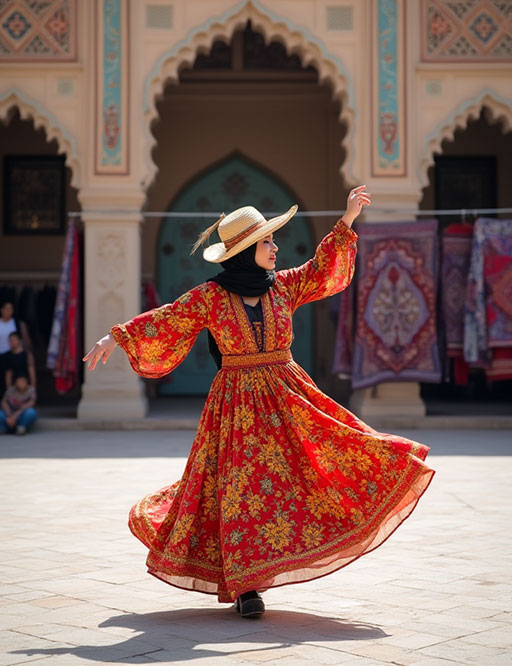
The Uyghur people are a Turkic ethnic group with a history stretching back over a thousand years. Their homeland, which they call East Turkestan (officially the Xinjiang Uyghur Autonomous Region), was a vital hub on the Silk Road. Cities like Kashgar were legendary melting pots, where merchants, monks, and mystics exchanged not just goods, but ideas, art, and faith, creating a culture that is utterly distinct from that of Han China.
The Sound of the Soul: The Uyghur Muqam
If you want to understand the heart of the Uyghur people, you must listen to their music. The Uyghur Muqam is the pinnacle of their artistic achievement, a vast and complex musical tradition recognized by UNESCO as a masterpiece of intangible heritage.
The Muqam is not just a collection of songs; it is a grand suite of music, poetry, and dance that can take hours to perform. It is a complete emotional journey, expressing everything from deep love and spiritual longing to profound sorrow and joyful celebration. Performed on traditional instruments like the long-necked dutar and bowed satar, the Muqam is the living, breathing soul of the Uyghur people, a sacred library that holds their history, identity, and deepest feelings.
A Taste of the Oasis
Uyghur culture can also be understood through its delicious and unique cuisine. This is not Chinese food; it is pure Central Asian comfort and hospitality on a plate.
-
Laghman: The most iconic dish might be laghman, thick, hand-pulled noodles that are stir-fried with lamb, peppers, and other vegetables. It’s a hearty, savory masterpiece.
-
Polo: Another beloved staple is polo, a pilaf of rice, tender lamb, and sweet carrots, steamed to perfection.
-
Kebabs and Nan: Lamb kebabs, seasoned with cumin and chili, are cooked in a tandoor, a traditional cylindrical clay oven that shows a clear connection to the cuisines of Central and South Asia. This oven also produces their staple bread, a delicious round flatbread called nan, which is a part of every meal.
Food is a communal affair, often enjoyed in lively teahouses that have long served as the social heart of their communities.
An Unbreakable Thread of Identity
Today, the Uyghur culture is facing an existential threat. Under the policies of the Chinese government, their language, their Islamic faith, and their unique traditions are being systematically suppressed in their homeland. Mosques have been destroyed, the Uyghur language is being replaced by Mandarin in schools, and countless cultural leaders, artists, and intellectuals have been imprisoned. It is a deliberate effort to erase a people’s identity.
In the face of this immense pressure, the preservation of their culture has become an incredible act of resistance and resilience. The global Uyghur diaspora works tirelessly to keep their heritage alive. They teach their children the Uyghur language, they perform the sacred Muqam, they cook the food of their ancestors, and they tell the world their story.
They are fighting to ensure that their vibrant traditions are not relegated to a museum. They are fighting to keep the thread of their identity unbroken. To learn about and remember the Uyghur culture is to stand in solidarity with a people who refuse to be forgotten, whose spirit, like the melodies of the Muqam, continues to echo with profound strength and beauty.


