
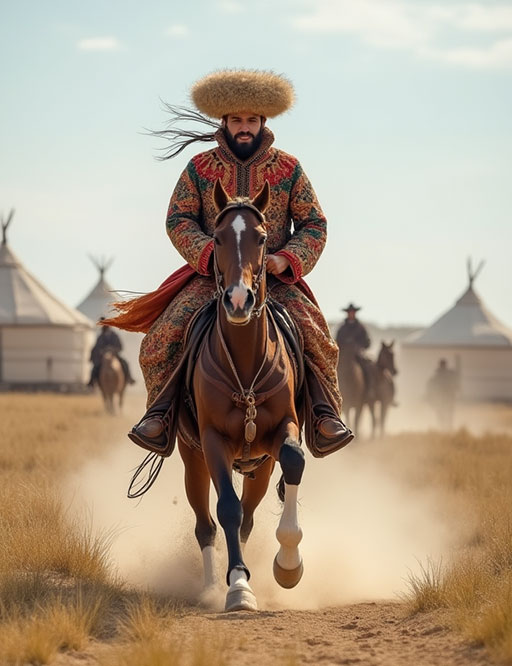
For centuries, the Turkmen tribes roamed the vast deserts and steppes, their lives a testament to endurance, skill, and a deep understanding of a harsh environment. Their modern nation, Turkmenistan, has elevated the ancient symbols of this nomadic life into pillars of its identity, creating a culture that is both deeply traditional and fiercely proud.
The Soul of the Steppe: The Akhal-Teke Horse
You cannot begin to understand the Turkmen without first understanding their reverence for the horse. They are the creators of one of the most ancient and breathtaking horse breeds in the world: the Akhal-Teke. These are the “golden horses,” famed for their incredible speed, intelligence, and a unique metallic sheen to their coat that makes them shimmer in the sun.
To the Turkmen, the Akhal-Teke is not a beast of burden; it is a member of the family, a divine creature, a source of ultimate pride. A Turkmen proverb says, “The Turkmen’s home is on his horse.” These celestial horses were the ultimate status symbol, the key to survival in raids and on long journeys, and a cherished companion. Today, the Akhal-Teke is the national emblem of Turkmenistan, a living symbol of the nation’s soul.
A History Woven in Wool: The Turkmen Carpet
If the horse is the soul of the Turkmen culture, then the carpet is its heart. A Turkmen carpet is far more than a beautiful object; it is a family’s story, a tribe’s signature, and a portal into their world.
These hand-knotted masterpieces, typically dyed in rich, deep reds derived from local plants, were essential to nomadic life. They served as insulation for the yurt, as prayer rugs, and as decorative hangings. But their true significance lies in their patterns.
-
The Göl: Each Turkmen tribe has its own distinct, intricate geometric emblem known as a göl. An expert can identify the tribe that wove a carpet—be it Teke, Yomut, or Salor—simply by reading its göl. It is a tribal coat of arms woven in wool.
-
Symbolism: The intricate patterns surrounding the göls are not random. They are a symbolic language, depicting the desert landscape, the animals they herded, and the hopes and beliefs of the weaver.
A Turkmen carpet is a piece of woven identity, so central to their heritage that it also features prominently on the national flag.
Life in the Black Sand
Over 70 percent of Turkmenistan is covered by the Karakum Desert. Living in such a vast and unforgiving environment has instilled in the Turkmen people a spirit of incredible toughness and a deep-seated tradition of hospitality. In the emptiness of the desert, a stranger is a rare and welcome sight. A guest is considered a gift from God, and they will be offered the best food and drink a family has, no questions asked. This sacred duty of hospitality is a cornerstone of their social fabric, a law of survival that has become a cherished part of their character.
The modern Turkmen culture is a unique and often enigmatic blend of this ancient nomadic heritage and a post-Soviet national identity. Their epic poems, like the Epic of Koroghlu, are still told to the accompaniment of the two-stringed dutar, recounting tales of heroic deeds and magnificent horses. It is a culture that looks to its powerful past to define its present, a proud nation of the desert whose heart still beats to the rhythm of a galloping horse.


