
At the very heart of the Diné way of life is a single, powerful concept that governs everything: Hózhó. This word is untranslatable into a single English word, but it is a state of being that encompasses balance, harmony, beauty, and order. To “walk in beauty” is to live in Hózhó—to be in a right and harmonious relationship with yourself, your community, the natural world, and the spirit world. Sickness, sadness, and conflict are all seen as a state of being out of balance. The goal of life, and of all ceremony, is to maintain and restore Hózhó.
The Land is the Heart: Dinétah
The Diné homeland is Dinétah, a vast territory in the American Southwest bordered by four sacred mountains. This land of dramatic mesas, deep canyons, and endless sky is not just a place they live; it is a sacred, living entity. Every canyon, spring, and mountain has a story and a spiritual significance.
Their connection to this land is so profound that their most traumatic historical event, the Long Walk of the 1860s, was an act of being ripped from their very soul. The U.S. government forcibly marched thousands of Diné hundreds of miles to an internment camp. The immense suffering was not just from the journey, but from the spiritual devastation of being separated from their sacred land. Their eventual return is one of the most powerful stories of resilience and cultural survival in American history.
Creating Harmony: Weaving and Silver
Navajo art is world-renowned, but it is much more than just a craft. It is a physical act of creating Hózhó.
-
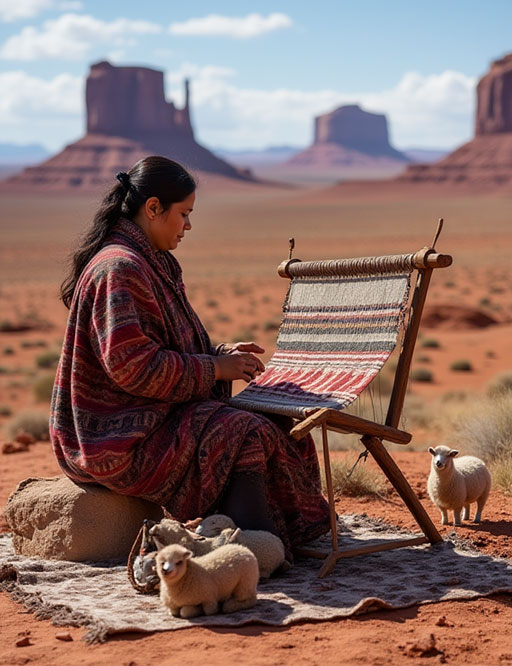
Weaving: A Navajo weaver works at her loom, creating intricate geometric patterns. The act of weaving is a spiritual process. The artist puts her thoughts, prayers, and spirit into the rug, creating a tangible piece of beauty and order from the chaos of individual threads.
-
Silversmithing: The creation of silver and turquoise jewelry is another iconic art form. Turquoise is a sacred stone to the Diné, representing the sky, water, health, and protection. Wearing a piece of beautiful silver and turquoise jewelry is a way of adorning oneself with the blessings of Hózhó.
The Sacred Home and Healing
The traditional Diné home, the hogan, is a sacred space. It is a microcosm of the Diné universe, with its door always facing east to greet the rising sun. It is a place of family and ceremony.
When a person falls out of Hózhó and becomes ill, a medicine man, or Hataałii, is called to perform a healing ceremony. A central part of many of these ceremonies is the creation of a sandpainting. Using crushed minerals and sands, the Hataałii creates a complex and beautiful sacred image on the floor of the hogan. The patient sits on the painting, absorbing its healing power. The painting acts as a conduit, a portal for the holy people to come and restore the patient to balance. Afterward, the sacred painting is erased, its purpose fulfilled.
The Navajo culture is a timeless lesson in the importance of living in balance. It’s a worldview where beauty is not just something you see, but something you actively create and live within.


